Little fact about us this week:
We once tried to take a spontaneous holiday. One of us packed a week early with a printed itinerary and all the documentation we needed in case we got stuck. The other showed up with toiletries missing and two chargers for devices he didn’t bring. It’s a miracle we make decisions together at all. But here we are.
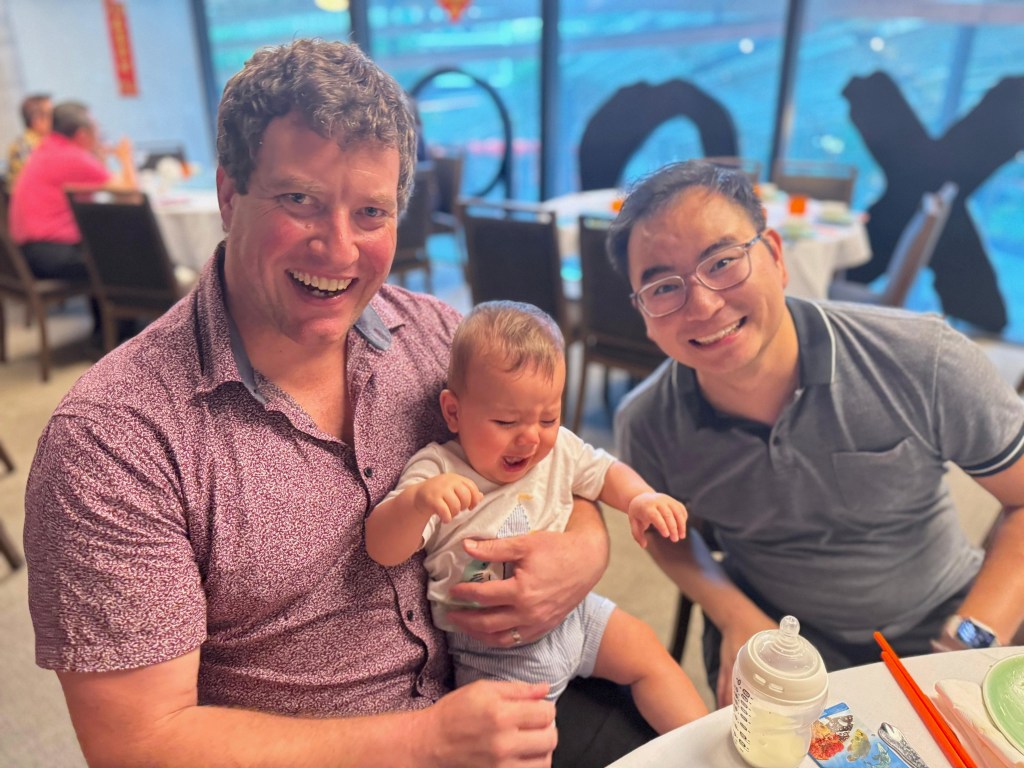
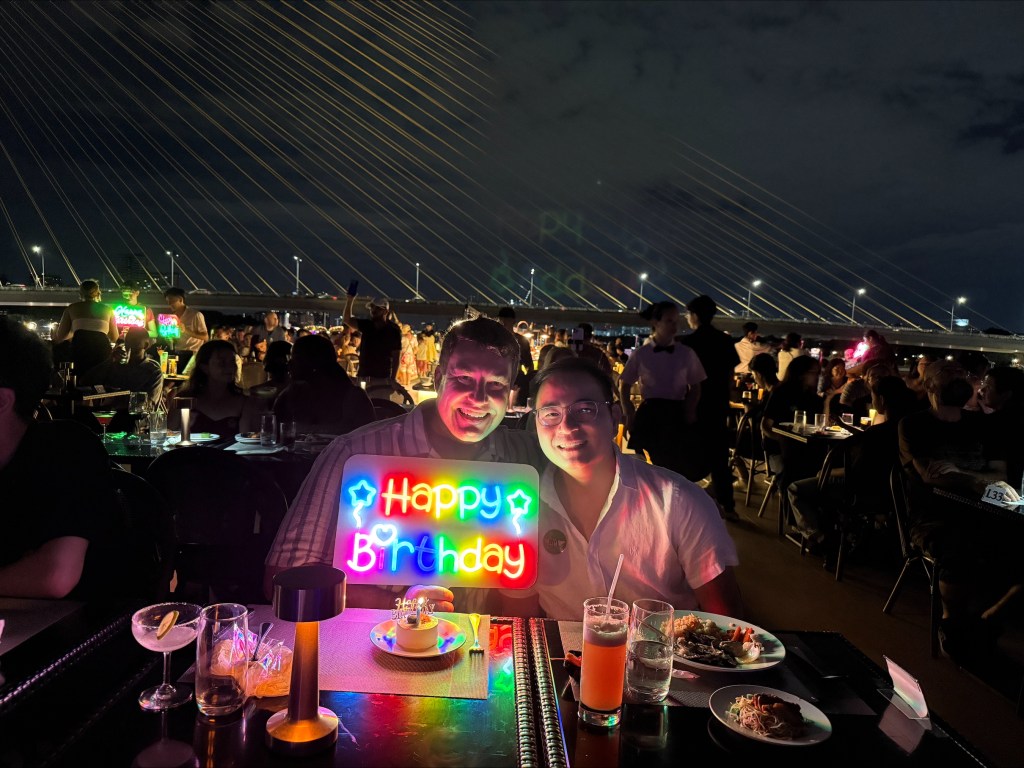
Our photo:
A glimpse into our future as parents of a baby – starring Gary’s godson Charlie. I would also like to add that he was crying well before Sam held him (it wasn’t us!).
It’s a packed post this week folks, buckle up as we explore our domestic/international situationship!
Our surrogacy setup: local love, global genes
When people hear we’re doing IVF and surrogacy, they usually assume we’re heading offshore for the whole thing – quick, transactional, and maybe with a tropical or rainforest backdrop. And while that’s true in most cases, especially (anecdotally) when it comes to two males looking to embark on this journey, amazingly enough, we’ve kept things mostly domestic.
Why we’re keeping it local, and why that matters
Choosing domestic surrogacy wasn’t just about geography – it was about values, it was about lived experience, it was about shared memories, and it was about connection.
In Australia, surrogacy is altruistic. That means our surrogates are doing this not for profit, but for connection. For intention. For something that looks a little more like chosen family and a little less like a transaction. And that just… felt right.
We wanted this journey to be deeply relationship-based. The kind that’s built on trust, mutual respect, shared memes, messy group chats, and the occasional teary voice note. Something real. Not just a process that ends with a handover, but one that begins with honest conversations and (hopefully) continues long after our future child arrives. A connection you can’t pay for, only nurture.
We also feel incredibly lucky, and still slightly floored, that the people who offered to carry for us are local and we already knew. Amazing, generous, beautiful women from within our chosen family circle. Actual people from our world. Not strangers from a database, not someone we were matched with online, but individuals who already knew us, saw our hearts, listened to our dream, believed in it, and said, “Yeah, I’ll walk that road with you.” That kind of offer… it hits differently.
We liked that.
But here’s the part most people don’t realise: local surrogacy is not an easy option.
Not by a long shot. And we are so incredibly lucky.
So what does a domestic surrogacy look like then?
It’s long. It’s layered. It’s, frankly, bureaucratic as hell. We’re talking months of paperwork, assessments, mandatory counselling, psychologist reports, legal reviews, ethics committee submissions, background checks, and medical testing. We’ve been at this for nearly a year already, and we’re only just approaching the actual IVF part. For some people, it takes them almost two years just to get past the testing, let alone finding a surrogate.
There are no shortcuts. Every step is scrutinised. Every form requires three, four, five signatures and a legal dictionary. There are hoops. Then there are flaming hoops. Then there are flaming hoops held by someone asking, “Have you considered the emotional impact of jumping through this flaming hoop?”
And you would think it might be the same in every state and territory to make it easier. Well, no. The laws vary wildly between Australian states. What’s allowed in NSW might not be allowed in Victoria. And forget a national framework, we’re stitching our process together with good intentions, Google Docs, and a high tolerance for emails marked “URGENT.” More on that later.
There are also no guarantees. Just because someone offers to carry for you doesn’t mean you can start IVF next week. It means you start a months-long, state-approved, ethically reviewed, medically assessed journey where everyone involved has to be 200% ready and resourced before you’re allowed to begin.
And yet, despite all that it’s the path we chose. Because at the heart of all that red tape is something beautiful: a village of people saying yes, again and again. A chance to build something with intention, not convenience. And a child who, one day, will get to hear the full story of just how many people showed up out of love.
It also means we get to be deeply involved – every scan, every message, every “yep, I’m still craving chocolate” moment. That level of closeness has been so important for us as first-time dads who want to feel the journey, not just arrive at the destination.
So, is going global bad?
We could’ve gone overseas, paid top dollar, skipped a huge chunk of the bureaucracy, and potentially have had a child sooner in a less complex/regulated environment. And you know what, this works for some people. This process isn’t really all that easy either because somehow you have to get your now new child back into the country. This might be easier for hetero couples (noting it’s still a challenge), but for homo couples, well how do you explain how a baby popped out of two guys?
Look, we totally get the appeal. International surrogacy can seem faster, more straightforward, and sometimes (on paper at least) easier. A tempting escape from the endless red tape and ethics committees back home. But here’s the thing: when we looked closer, we just weren’t 100% confident that we would be able to make it work for us.
In some countries, commercial surrogacy is legal but largely unregulated. That means while there may be contracts and clinics, the laws protecting the rights and wellbeing of everyone involved, especially the surrogate, aren’t always strong. And that made us uncomfortable. We didn’t want to navigate a system where money could be the driving force instead of mutual respect and informed, ethical choice.
Plus, let’s be real: the legal and immigration logistics alone are enough to give you stress hives.
In most international surrogacy arrangements, the child is born overseas and then needs to be granted citizenship and a passport before you can bring them back to Australia. That process? It can take weeks, and in some situations sometimes even months. You’re in a foreign country with a newborn, while jumping through legal hoops to prove parentage, meet local regulations, and satisfy the Australian government’s requirements. Not exactly the chill post-birth bonding vibe we were hoping for.
Some countries require court orders, DNA testing, or extra affidavits just to process the child’s travel documentation. And let’s not forget the legal parentage doesn’t always transfer smoothly, which means you might return home with a baby who, legally speaking, isn’t yet recognised as yours. Yikes.
The risk of getting stuck overseas in legal limbo, or worse, being separated from your child, isn’t just theoretical. It’s happened. And after the pandemic, no one wants to be stranded across the world from their support network when they’ve just become a parent. Least of all two gays with limited language skill, a pram they haven’t assembled yet, and who’ll probably need a case of wine just to get through the nursery build.
Now, that’s not to say people can’t or haven’t had beautiful, respectful international surrogacy experiences, many have, and we love that for them. There are several international countries like Canada for example who also follow a model of altruistic surrogacy that couples often choose to go to instead. And there are other countries where there are tight regulations and screening beforehand. At the end of the day, it’s a deeply personal choice for any couple involved and the journey they want to embark on.
So yes, domestic surrogacy is usually much slower, more complex and far less convenient. But it’s also rooted in mutual understanding, shared decision-making, and the kind of legal clarity that means we can focus on preparing for our future child, not embassy appointments. And to us, that’s worth it.
PSYCH. Plot twist – our eggs are from the USA
Now here’s where we bend the narrative. While our surrogacy is proudly local, our donor eggs are international. A little global flair in our otherwise homegrown recipe.
Why? Because finding a known donor here in Australia is really, really hard. Like, “win-the-lottery-while-holding-a-flat-white-and-wearing-a-Mardi-Gras-cape” hard. Australian laws around donor anonymity and advertising are strict and for good reason. They’re designed to protect everyone involved. But they also mean you can’t just put up a friendly Facebook post or hang flyers in your local café saying, “Wanted: Person with incredible ovaries and great energy.”
So, we looked overseas. And honestly? It opened up the world, literally.
Going international gave us more choice. More detail. More alignment. We were able to read about potential donors, understand their stories, values, health backgrounds, even little things like whether they’re into music, painting, or doing headstands at yoga. It wasn’t about finding a “perfect” donor because that’s not real. It was about finding someone who felt right. Someone whose story made us pause and smile and say, “Yep, this feels like the beginning of something meaningful.”
We’ve always said that genetics don’t make a family. It’s about love, intention, and consideration so having this level of connection with our donor’s profile helped us feel grounded in the process. It gave us context. It gave us clarity.
And most importantly, it gave us something to one day share with our child. Not just a medical form or a name in a database, but a story. One that’s honest, transparent, and rooted in respect. One that says, “You were wanted, deeply and completely, right from the very start.”
The legal patchwork quilt of Australia
You’ve heard us talk about this a million times over by now (impressive since this is only our 4th post) but here’s the thing: Australian surrogacy law isn’t one unified system. It’s more like a patchwork quilt stitched together by eight different aunties and nannas, all with their own opinions and patterns. Every state and territory has its own rules, its own processes, and painfully, its own quirks.
We live in New South Wales, which (thankfully) sits on the more sensible end of the scale. It allows both partnered and single people to pursue altruistic surrogacy, has clear requirements, and a fairly structured process. Still complex, but doable.
But cross a state line? Suddenly, the landscape shifts.
In Western Australia, for example, surrogacy for male couples was only legalised very recently (after years of advocacy and a lot of lobbying). In Queensland, advertising to find a surrogate is illegal, that is even just saying “we’re looking” can get you into trouble. In South Australia, you’ve got to go through extra rounds of approvals and legal oversight. In the ACT, you may find smoother processes and less legal jargon, but in the NT, surrogacy isn’t even legislated, which means nothing is formally allowed or protected.
Some states require you to go through post-birth court processes to be legally recognised as the child’s parents. Others place restrictions on who can be a surrogate, or who can be an intended parent. Some are more progressive; others feel like they were written when fax machines were cutting-edge.
And this matters a lot.
Because where you live can change everything; your timeline, your legal risks, your relationship with your surrogate, and even your rights as parents. It’s one of the biggest reasons we chose to keep things domestic and local to NSW.
Morals, emotions, and everything in between
We hear this side a lot. Even when you’re recounting your journey to someone and another person says “I don’t think I could ever do that” or “I don’t think I could ever be a surrogate”. And it’s not said with judgement, it’s usually said with awe. But the thing is, we get it. This isn’t for everyone. It’s big. It’s complex. It asks a lot of everyone involved. And that’s exactly why we’re in such awe of the women who can. Who do. Who offer something so extraordinary, it reshapes your entire understanding of generosity and love.
For all the forms, the fees, the checklists and the court-approved acronyms, this journey isn’t really about logistics. It’s about love. And every single choice we’ve made has been wrapped in self-reflective emotion and carefully considered decisions.
We’ve had late-night chats and early-morning doubts. We’ve sat at the kitchen bench debating ethics, in the car talking through fears, and on the lounge holding hands (occasionally) while re-reading a donor profile for the fifth time. We’ve cried a bit, laughed a bit more, and emotionally processed everything from parenting styles to birthing locations. (Seriously, we didn’t even know we had opinions on that until now.)
There’s a kind of vulnerability in this process that catches you off guard. It’s the weight of knowing someone else is helping you bring life into the world – not as a transaction, but as a gift. It’s the responsibility of choosing an egg donor not just for biological contribution, but for the story you’ll one day share with your child. It’s asking questions like:
- How will we explain this journey in a way that makes our kid feel proud?
- How do we honour our surrogates – not just now, but forever?
- How do we make decisions now that our child will one day feel in their bones as love?
- How are we going to tell our kid where their genetic material comes from?
And through all of it, when we’ve been overwhelmed, or unsure, or just plain knackered, we’ve come back to one guiding question: “Will this help our child feel loved, seen, and safe?”.
The yellow brick (very long) road….
So yeah, maybe we’ve taken the scenic route. The longer, slower, slightly more paperwork-scented version of this journey. But every form, every checklist and assessment, every international midnight call to the USA, has led us somewhere meaningful. It’s helped us build something that already feels solid.
We didn’t set out to be trailblazers or advocates or emotionally available gays with a penchant for legal and baby jargon. We just wanted to become parents in a way that felt right. And sometimes doing what’s right for you means choosing the path with more potholes but better scenery.
To anyone else walking a path like this (or thinking about it): you’re not alone. The road might be a little overgrown, the signage inconsistent, and the destination hard to picture at first, but there’s magic in the mess. And if your gut, heart, and spreadsheets are all saying yes… keep going. We are.
Right, well that’s all folks, signing off exhausted, egg-sourced, emotionally untangled, and still waiting on a callback from Border Force to clear our egg delivery.
Love,
Gary & Sam 🐨💖✈️👨👨👦👦



 Two dads and a dream
Leave a comment