Little fact about us this week:
If we had a girl, one of us would be called daddy and the other dad. If we had a boy, it would be other way around. We’ll leave you to guess who is who 😉
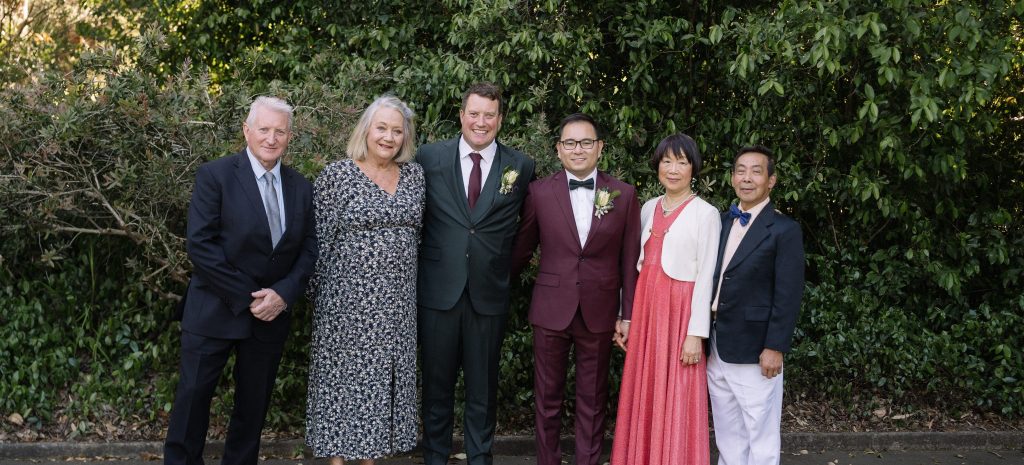
Our photo:
Completely unrelated to the post but say hello to our family village patriarchs and matriarchs! If you can’t tell whose side is who’s, then….
Survivor: Petri Dish Island
You know one thing we’ve not asked? How and where exactly do they thaw out frozen eggs? Is it done in a tube? Is it done in a petri dish? Do they just pop the tube in cold tap water and defrost them like we do frozen prawns? Someone knows.
We started the thaw process last Sunday. Why? Because it lines up with our surrogate’s cycle and everything she’s been doing since then to ensure that she creates the comfiest environment for our baby peanut butter to grow in. If you’ve missed this part, you can skip back and read the previous post. The marvel of modern medicine plays its role here in ensuring everything is almost perfectly timed.
And, excitingly, we got word that all our thawed eggs survived. That’s right, all of them. Cue all of us (surrogate and her wife included) doing a little happy dance (quietly, because hormones).
First, if you’ve ever heard that some eggs don’t survive thawing (we’ve only been harping on about it for weeks), that’s not just IVF folklore. In typical egg-thaw cycles, especially using vitrification (that very fast freeze method), statistically almost 40% – 50% of the eggs may not survive.
Secondly, being a male gay couple, it’s not exactly like we have eggs on tap. Mentally, we were geared for loss. Emotionally, we were reserved, apprehensive, and maybe already reacting to loss because we expected loss.
So hearing all 8 of our eggs did make it through Survivor without being eliminated, well that’s well above average and they’re little fighters already (or there were a lot of immunity sticks to go around). It feels like winning a small lottery with biology, but also proof that our clinic, our donor eggs, and the freezing method and unfreezing method was all top tier.
Tangibly, it adds real extra margin of hope for what comes next. It’s the best possible start we could’ve hoped for and we don’t take that lightly. The process is loaded with unknowns and as we go deeper into this world, it’s becoming such a clear reality of the position that we’re in.
“Standby ‘Hope’, ‘Embryo’ – go ahead”
So, with the hurdle of thawing eggs behind us, embryos are now being made. Our surrogate continues to prep her body simultaneously.
Since day 1 of fertilising the egg with Sam’s sperm, the lab team have been monitoring our embryo to see if it meets certain milestones. Now, in this process we are definitely going to lose embryos, as in, they won’t make the grade that would be considered suitable for continuing/transferring, or they just die off. In fact, we’ve already been told that one of our embryos was ‘iffy’. This happens, naturally, it’s like how hetero couples might not be able to fall pregnant straight away. So, what are they looking for?
It’s called embryo grading. And it’s important. Here’s how embryo grading works / what they are looking for, because apparently, it’s like Tinder for cells:
- Embryos are monitored for how they divide: are the cells splitting evenly? Is there fragmentation (tiny bits that don’t look clean)? Is the growth on schedule for what a healthy embryo should look like at that stage?
- At around Day 4, embryos might be at the morula or compact stage. If they look promising, they continue to blastocyst (Day 5) stage. The later stage gives more info for viability.
- Embryologists also grade blastocysts by letters/numbers (using systems like Gardner’s): expansion, inner cell mass (ICM), trophectoderm (cells which will become placenta), and how well the embryo is forming. “5AA” is often seen as very good and so forth, so yes, it feels like your future baby is sitting an exam already and being tested on their future worth.
Importantly: we will only transfer one embryo. In Australia, and specifically at IVF Australia, only one embryo is transferred at a time, a policy we support wholeheartedly. It prioritises safety for our surrogate and increases the chance of a healthy pregnancy. No twins, no gamble. Just the best chance for one strong little baby peanut butter to take root.
The plan: check in on the embryos at Day 4, and then likely do the transfer on Friday. Yes, that’s right, this Friday being the 19/9. We don’t yet know what time (they always keep that a bit mysterious, don’t they?), but you can bet we’ll be pacing and refreshing every hour.
What comes after (if all goes well)
So, if the embryo grading is good and our lucky embryo is picked, here’s what the next 48‑72 hours look like:
- Embryo transfer occurs (likely Friday). It’s quick: catheter, under ultrasound, embryo placed, then rest as prescribed.
- Progesterone support continues; every step after that is about keeping the environment as friendly as possible.
- Then comes the wait: typically, 10‑12 days after transfer to test pregnancy (blood test). The usual mix of hope, nerves, trying not to google everything, and importantly not descending into panic, chaos, and absolute oblivion.
Meanwhile, we’re also getting practical: private hospital cover, choosing an obstetrician, budgeting for prenatal and antenatal appointments, planning the supports we’ll need to put in place to ensure we continue to support our surrogate, figuring out what our out‐of‑pocket will be. Because yes, the biology is massive, but the management of all things pre and post is just as real.
The not-so-fluffy yolky stuff (haha get it? egg? yolk? nevermind…)
As fun as this blog tries to be, I think for one of the first times, I want to take the time to do some serious talk. Hang tight, this section’s long, and is probably more of a therapeutic journal entry for me more than anything else to recognise and validate where we’re at emotionally, mentally, and physically.
Personally, I’ve stopped telling people that I’m tired or that it’s been a bit more stressful than I originally anticipated. Why? 9 times out of 10 I get the response of “wait till your kid is born!”. And while I don’t know their individual stories and there may be some (or a lot) of truth in that statement, I do wonder whether the people that say this to me, or us, have actually been through the same process.
I am definitively sure that this process will be worth it at the end, that what we’ve been going through will just be a distant memory and we will see the proverbial ‘light at the end of the tunnel’, and there’s not a doubt in my mind that we wanted to give this a shot.
We’re excited. Absolutely. But part of this journey means living with and coming to terms with a lot that’s not in our hands. This can be anything like when things haven’t gone to plan, things have taken longer than anticipated, the ever changing and rapidly evolving landscape, the uneven pace in which this whole process happens (you wait for months for nothing then everything happens all at once), or the simple fact that ‘this is how it’s done’.
There are days when the science, the clinic protocols, the schedules, and the expectations feel like they wrote the script and we’re just actors trying to hit our marks without knowing the next scene. Because with IVF + surrogacy, so much is pre‑determined by medical professionals, institutions, and precedent: which embryos make it, which thresholds are “transfer‑ready,” when meds ramp up, how many ultrasounds happen, when payments need to be made, what legal forms are required, are you ethically and mentally suitable parents, whether our arrangements are appropriate, do we have the appropriate finances for this undertaking, are your egg and sperm genetically high risk, the list goes on.
If we had the option to carry our own baby, or simply get pregnant naturally, some of these scripts wouldn’t exist. For most, it’s a lucky adventure, a journey, sometimes simple, sometimes hard, but naturally, no one’s going to say you can’t get pregnant because you don’t have a legal contract with your partner about who’s going to do the babysitting the following week and have you thought about how your childhood experience might set you up to be a bad parent. But this path has its own rules. And learning them has been both empowering and exhausting.
I did a lot of reading over the last few days to understand the why and how of what we are sometimes feeling. A lot of what I’ve read in support forums or intended‑parent articles echoes this: a sense of being on an emotional rollercoaster with limited controls. Anxiety about “what if the embryo doesn’t reach blastocyst stage,” apprehension when you think about the cost, guilt if anything negative were to ever happen to your surrogate, frustration over not being able to attend every appointment, debating whether you do this a second or a third time when it’s not your body, longing for normalcy. “Is this waiting period ever going to end?” is a common refrain. Forums are full of people describing the two‑week wait as “nothing and everything all at once.” There’s also an unmistakable and relatable talk of grief and trauma surfacing unexpectedly. Not always loss in the worst sense, but grief over milestones passed, wishes unmet, and expectations changing. Even when the outcome is positive, there’s often overlooked grief for what didn’t happen in a “normal” way. “I will never carry a baby,” or “I didn’t get that first‑kick moment myself” are things many intended parents write about – because after all, we’re not the ones who get to have this experience carrying. The birth of life is a miracle, is such a huge gift, and we’re not intimately delivering that, but we are constantly reminded of it.
Supporting those who support us is part of the mental work. Mental load refers to the invisible cognitive and emotional labor involved in managing a household and family, often leading to feelings of overwhelm and burnout (Healthline 2020). We often read that strong communication, respect for boundaries, and clear emotional check‑ins are gold. Sometimes, for example, intended parents say that they forget to ask their surrogate how she is holding up, emotionally, because the relentless forward‑momentum of “what we must do next” takes over. But those moments matter. A text asking “How are you really” after a clinic appointment, a gratitude note, an acknowledgement of what she is sacrificing, these small things anchor us all. We’re in such an amazingly privileged position where our surrogate and her wife have done this before, that there’s not much we do need to worry about when it comes to a safe pregnancy; not everyone, obviously, has the same opportunity. But it’s also about those closest to us who may be trying to figure out how to help us, support us, or are genuinely curious about our progress, keeping them updated, making sure no-one is left out of the loop, making sure we explain things at the right level, etc.
Flipping that, I have also read that rarely do people ask the intended parents how they’re going. This seems to be an overwhelming general consensus, at least in the social groups (thanks Facebook), amongst IPs. There are many reasons I think that this happens, and I could never begin to speculate or assume why IPs don’t also require a check-in. From personal experience, our surrogate and her wife, our dearest family, and our closest friends, have always dropped a line to ensure we have been doing okay – and in that sense, I think we are lucky compared to others.
For me, something I’ve been tackling recently, is an absolute persistent underlying sense of isolation. Being an administrator and a mediator is tough. Funnily, when this was mentioned to me in counselling and in our psychology session at how big this role actually is, I never afforded it much attention – I’ve done it many times before for many other things, right? Wrong. Balancing expectations, communicating effectively and clearly, planning our next steps, and just making sure we’re all accountable, has been more demanding than expected…or maybe I’m just getting old haha.
Even with our small but extraordinarily amazing network of friends, supportive families, even with professional counselling, there are feelings that we’re not sure people will fully understand. Things like having to keep certain fears private – “What if nothing works?” or “What if I don’t cope when we fail?”. Online forums become lifelines: real people saying, “I felt that too”, “Yes, I worry about the unknowns.” That shared vulnerability helps.
Physically, it’s also a challenge. Babies aren’t cheap. Neither is pregnancy that gets us there. So far? We’ve spent almost $80k, with another anticipated $35k costs left to go…and that’s if everything goes well on round 1. I can’t even begin to imagine what couples who have done this multiple rounds over have gone through financially. If we won the lotto tomorrow (our amazing surrogate is manifesting that we do), we’d be sweet. But the reality is we must balance work, social supports, our fatigue and mental health, and all the other expectations just to ensure we get from Point A to Point B because we’re not financially straddled.
But this isn’t a post to complain, or whinge, or come across as ungrateful. Truthfully, we couldn’t do this without knowing we have such a strong support network behind us. People we know will come the moment we call them, be available when we need them, and will be there with and for us till time stands still – peanut butter or no peanut butter. So, we’ve started leaning harder into practices that help us stay resilient:
- Daily rituals that slow things like decompressing after work.
- Talking openly with each other about our fears, and being real about our feelings, even the weird ones.
- Giving ourselves permission to step away from the journey when we need to.
- Celebrating small wins: “all eggs survived,” “good lab news,” “Our surrogate and her family are doing well today,” etc. Every little marker of progress means something.
And perhaps most importantly: allowing the evolution of the journey to change us. We entered this with certain expectations. Some we’ve let go of. Some we’re adjusting. It’s an absolute learning process and something neither of us have (obviously) been on before. The hope is always there, but we’re learning to stay grounded while our dreams stretch.
Because it isn’t just a medical process. It’s emotional, ethical, spiritual, relational, wild, beautiful, and messy. And so far, we’re holding on to that mess with as much grace (and humour) as we can muster.
Learning to love us, so we can love you
We always said that this blog was not only to document our journey, but as a (very long) love letter to our child. Baby Johnson, Baby Peanut Butter, well, you’ll have a tonne of affectionate names by the time we’re done.
Right now, you’re not here yet. You’re still a cluster of cells we’re cheering on from a distance. But we’re already imagining your eyes. Your laugh. Whether you’ll hate coriander, be allergic to chilli, or decide to start some macro diet (Dadda says you’ll be wrong, but daddy will love you anyway).
We don’t know if this is the transfer that will bring you to us. We don’t know if this embryo will grow into the person reading this entry in 20 years’ time with a cringe face. But we do know this…
As with all our posts about you, your surrogate’s discipline in creating the best opportunities for your earliest stages (thank her later), and all the wishes of the people around us have given, you have been absolutely loved into existence.
You are being hoped for, dreamed about, prepared for, by not just us, but a whole little village. Your surrogate, Hannah, is showing up with more strength, humour, and patience than we knew was possible. Her wife? Basically, your emotional godmother already. And us? We’re fumbling forward, holding on tight to the hope that this works.
You were not an accident. You were not a maybe. You were a decision that we would embark on this journey and see where it takes us.
It hasn’t been easy. It’s been humbling. Stretching. Sometimes scary. But also… so full of purpose. We’ve had to relearn how to love ourselves, love each other, and love those around us. So, before you were even cognisant of your own existence, you’ve already made your parents grow.
So, wherever you are, blastocyst, baby, teen, adult, we just want you to know we all were here from when you decided to fight your way into existence from a sperm, egg, and a petri dish (honestly, is this where they grow the embryos?!?!?!).
Signing off:
If love could implant embryos, we’d be pregnant already. Until then: science, spreadsheets, sarcastic optimism.
Love,
Gary & Sam 🥚🧬😅






 Two dads and a dream
Leave a comment